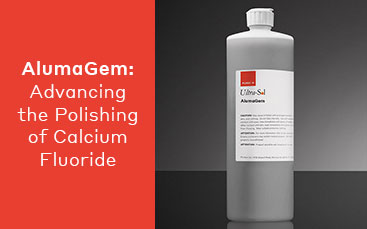
AlumaGem: Advancing the Polishing of Calcium Fluoride

AlumaGem: Advancing the Polishing of Calcium Fluoride

In modern optics manufacturing, precision isn’t optional — it’s the baseline. Among the materials that shape the industry, calcium fluoride (CaF₂) stands out for its exceptional optical range, transmitting light from ultraviolet to infrared with minimal absorption. These qualities make it vital in laser systems, spectroscopy, thermal imaging and aerospace optics — yet its softness and crystalline nature make it notoriously difficult to polish. Conventional processes designed for harder materials like fused silica or BK7 often lead to surface defects and inconsistent finishes. Pureon’s AlumaGem platform was developed precisely to overcome that barrier.

The AlumaGem Advantage

The objective was clear: to develop a fast-polishing process capable of removing grinding damage while delivering exceptionally low surface roughness across both bulk and intermediate polishing steps. The result is a process that not only accommodates calcium fluoride’s sensitivity – it capitalizes on it.

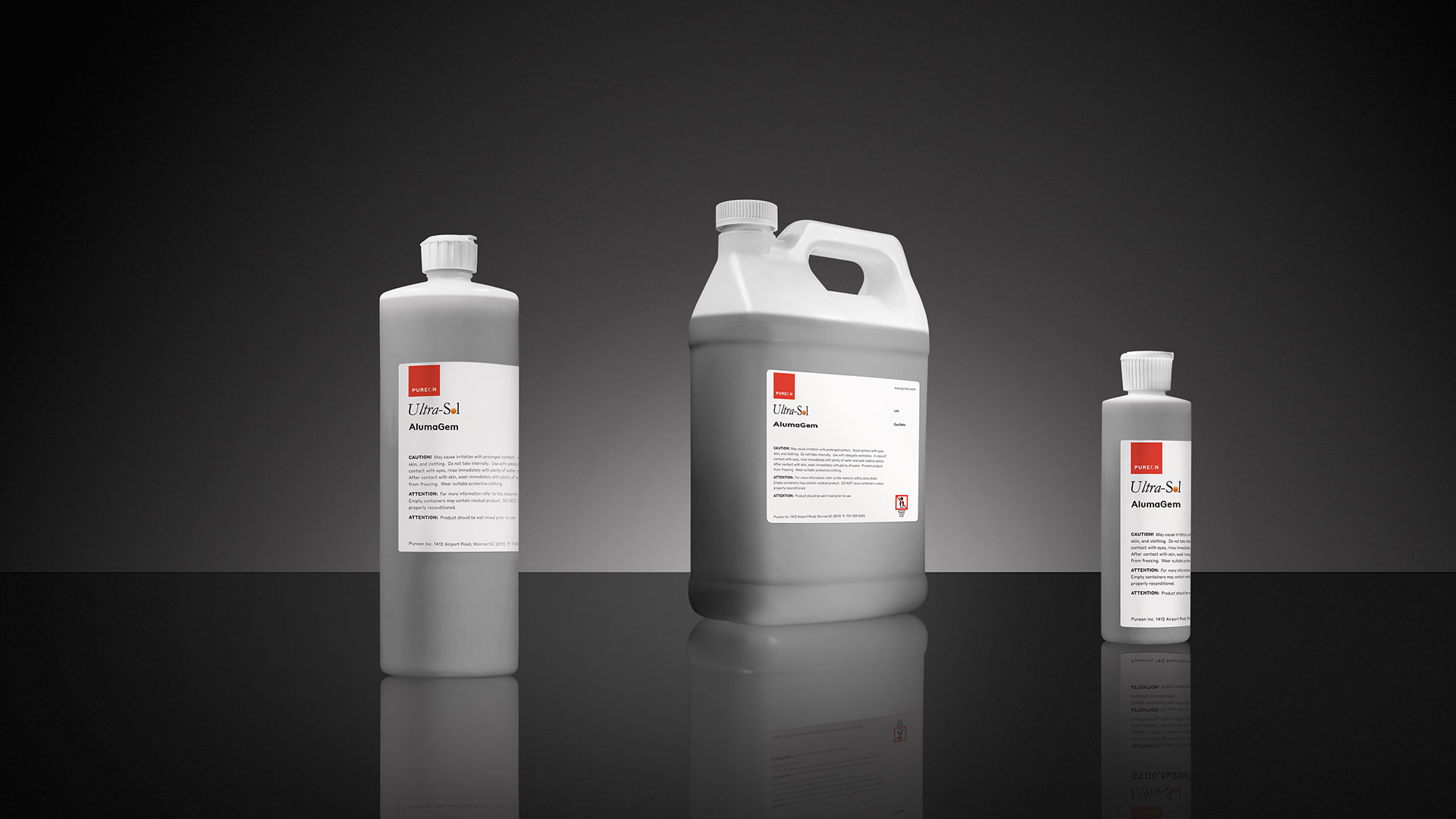
AlumaGem unites precisely graded diamond and alumina abrasives in an optimized carrier fluid. This dual-abrasive system allows fine-tuning across different stages of the polishing sequence. By adjusting particle size, the same platform can be used seamlessly from the bulk removal phase to the final finishing step – improving consistency, reducing process complexity, and maintaining high throughput without sacrificing surface quality.

Testing the Process

The development trials used 50.8 mm × 3 mm CaF₂ blanks (Crystran) on a Lapmaster 12 polishing system. Multiple pad types were evaluated – MHS15S, SUBA IV, and POLITEX – each offering distinct compressibility and hardness profiles. Surface roughness was measured with a ZeGage Pro HR Coherence Scanning Interferometer, providing precise 3D topography data at multiple surface locations (center, mid-radius, and edge).

The Results

  • Speed and consistency: Increasing pressure from 0.3 psi to 1.6 psi produced a 3.5× faster material removal rate with no loss in surface quality.
  • Process stability: Even under higher pressures, the polished surfaces exhibited uniform, low roughness values.
  • Diamond makes a difference: Formulations containing diamond abrasives achieved faster removal rates while maintaining the same level of surface finish as those without diamond.
  • The optimized two-step process:
  • 3 µm AlumaGem® on MHS pad at 1.6 psi
  • 0.25 µm AlumaGem® on POLITEX pad at 0.3 psi

Based on literature, low pressures have traditionally been recommended for processing CaF₂ to avoid subsurface damage and surface defects. However, Pureon’s findings challenge that assumption: higher pressures not only preserved the surface quality but also delivered significantly improved removal rates. Likewise, AlumaGem suspensions containing diamond proved markedly faster than identical formulations without diamond, yet achieved equivalent low surface roughness – demonstrating that higher efficiency no longer requires compromise.

This combination effectively removes grinding damage and yields a smooth, defect-free surface, proving that higher pressures – once considered unsuitable for CaF₂ – can in fact enhance both efficiency and consistency.

A Platform for Precision

The success of AlumaGem exemplifies Pureon’s vertically integrated innovation model: in-house research, application testing, and customer collaboration across the entire surface-finishing chain. The result is more than a product – it’s a reliable, data-driven process foundation for the next generation of precision optics.

Comments

  • Ravi
    December 1, 2025 at 11:06 am

    Excellent Articlee

Add a comment