
Metallography
High performance consumables


Pureon offers high-performance metallographic consumables for precise and reproducible specimen preparation. Our portfolio includes grinding pads, polishing pads, and diamond suspensions designed to deliver consistent results across metals, ceramics, and advanced materials.
With decades of expertise in metallography and surface finishing, we help laboratories and quality control teams optimize their grinding and polishing processes.
Need help choosing the right preparation process?
Ask our AI Metallography Expert below for instant recommendations on consumables, workflows, and best practices.
Metallography
Metallography is a central method of materials testing used to examine the microstructure and internal structure of metallic materials. It enables the detailed analysis of metals and alloys, from phase distribution and grain structure to grain size and potential material defects such as porosity, cracks, or inclusions.
Metallographic investigations are used in industry, research, and quality assurance. They help evaluate manufacturing processes, verify heat treatments, and reliably analyze material behavior under defined conditions. Through precise preparation and etching techniques, even the finest microstructural features can be made visible and assessed.
With the development of new materials, the broader term materialography has also emerged. While metallography focuses exclusively on metallic materials, materialography includes the investigation of all material classes such as metals, ceramics, polymers, composites, and coatings.
Metallography therefore represents a key subdiscipline of materialography.
Tasks of Metallography
Metallography plays a central role in materials testing and quality assurance. Its primary task is the investigation and evaluation of the microstructure of metallic materials in order to draw conclusions about properties, manufacturing processes, and causes of failure.
The most important tasks include:
1. Microstructure analysis
Investigation of structural composition, phase distribution, and grain structure to evaluate material properties.
2. Grain size determination
Analysis of grain structure to assess mechanical properties such as strength and toughness.
3. Verification of heat treatment
Inspection of hardening, tempering, annealing, and other thermal treatments through microstructural changes.
4. Failure and defect analysis
Identification of cracks, porosity, inclusions, shrinkage cavities, or other material defects to determine root causes.
5. Production quality control
Monitoring manufacturing processes and ensuring consistent material quality.
6. Coating and layer analysis
Measurement of coating thickness and evaluation of adhesion and microstructure.
7. Documentation and reporting
Preparation of standardized inspection reports for technical evaluation and verification.
Materialographic Testing
Materialographic testing is a destructive testing method in which a sample is taken from a component and microscopically analyzed after preparation to draw conclusions about structure, phases, and potential defects.
Process of Materialographic Testing
Materialographic testing follows a structured and standardized procedure to evaluate the microstructure of materials. The process is divided into several coordinated steps.
1. Sampling
A representative sample is extracted while considering component geometry, loading direction, and analysis objectives. Proper sample extraction is essential for reliable microstructural analysis.
2. Mounting
If necessary, the sample is embedded in a mounting medium (hot or cold mounting) to ensure edge stability and facilitate precise preparation.
3. Mechanical preparation
The surface is prepared through several grinding and polishing stages until it is flat, parallel, and free of deformation. The goal is an artifact-free surface suitable for microstructural examination.
4. Etching
Material-specific etchants are applied to reveal grain boundaries, phases, and structural features.
5. Microscopic analysis
Examination is performed using optical microscopy or, for higher resolution requirements, scanning electron microscopy (SEM). Parameters evaluated include grain size, phase distribution, precipitates, cracks, porosity, and inclusions.
6. Evaluation and documentation
Results are evaluated according to standards, documented with images, and summarized in a test report. Materialographic testing supports quality assurance, process validation, material characterization, and failure analysis.
Materialographic Cross Section
A materialographic cross section is a prepared material sample designed for microscopic examination of microstructure. The objective is to reveal the internal structure, phase distribution, and possible irregularities.
Preparation steps
- Sample cutting
- Mounting
- Stepwise grinding
Important influencing factors

- Material type
- Microstructure
- Objective of the analysis
Metallography – Polishing
During polishing, the surface is refined further to remove grinding marks.
Typical polishing steps:
- Pre-polishing
- Fine polishing
- Final polishing
Specialized metallography polishing machines and defined polishing media are used. The circular polishing method enables uniform and reproducible results.
Pureon provides grinding and polishing solutions specifically designed for metallographic sample preparation.
Metallography – Grinding
In metallographic grinding, deformation layers, cutting damage, and surface irregularities are systematically removed. Controlled material removal is critical to prevent microstructural alteration or preparation artifacts.
Diamond grinding pads for reproducible results
For coarse and fine grinding, high-quality diamond grinding pads from Pureon are ideally suited. They are available in grit sizes ranging from 125 µm to 3 µm, enabling efficient and reliable preparation of different materials.
Advantages:
- High material removal rate for efficient sample preparation
- Excellent edge retention for precise microstructure evaluation
- Uniform grinding pattern
- Reproducible results for serial testing
By using coordinated diamond grit sizes, the grinding process can be optimally adapted to the material and the analytical objective. This ensures a reliable basis for subsequent polishing and analysis procedures in metallography.

Metallography – Polishing
Polishing is the decisive step in metallographic preparation. The goal is a scratch-free and deformation-free surface for precise microstructure analysis.
With the PURE-DS diamond suspension series, Pureon offers optimized solutions for reproducible polishing results. These suspensions are available in monocrystalline and polycrystalline diamond variants and contain integrated lubricants for stable processing.
Your Advantages with PURE-DS:
- High removal rate with controlled surface quality
- Reduced preparation time
- Uniform and relief-free surface structure
- Optimized compatibility with various polishing cloths
- Reproducible results in laboratories and production environments
The combination of defined diamond particle size, integrated lubrication, and a matched polishing cloth ensures maximum process reliability and dependable metallographic evaluation.
For final polishing, a 0.05 µm OPS fine polishing suspension based on silicon dioxide (SiO₂) is used. Combined with the MAMBO polishing cloth, it enables chemical-mechanical final polishing and
For final polishing, a 0.05 µm OPS fine polishing suspension based on silicon dioxide (SiO₂) is used. Combined with the MAMBO polishing cloth, it enables chemical-mechanical final polishing and produces a highly reflective, relief-free surface.

Grain Size Determination in Materialography
Accurate grain size determination is a key element of materialographic analysis and provides important insights into strength, hardness, and mechanical behavior.
With our grinding and polishing media, including PURE-DS diamond suspensions and the OPS fine polishing suspension, samples are optimally prepared. The flat, scratch-free surface enables reliable analysis of grain size, phase distribution, and microstructure.
This allows laboratories and companies to obtain precise, reproducible results that are essential for quality control, failure analysis, and the optimization of manufacturing processes.
Grain Size and Strength in Materialography
The grain size of a microstructure is also a decisive factor influencing the mechanical properties of materials. It is affected by alloying elements, heat treatment, deformation processes, and cooling rate. Rapid cooling or high nucleation rates lead to fine-grained microstructures, whereas slow cooling often results in coarse-grained structures.
Relationship between grain size and strength
Fine-grained microstructures contain many grain boundaries that hinder the movement of dislocations. As a result, strength increases and the material becomes more resistant to external stresses.
Coarse-grained microstructures contain fewer grain boundaries. Consequently, they may be less strong at lower temperatures but can be more stable at higher temperatures. At elevated temperatures, the grain boundaries of fine-grained structures soften or flow more quickly, which reduces strength.
Advantages of fine-grain and coarse-grain structures at a glance
- Fine grain: higher strength at low temperatures, uniform material properties
- Coarse grain: better stability at high temperatures, easier microstructure interpretation
The precise determination of grain size in materialography is therefore essential for quality control, material selection, and process optimization.
Pureon grinding and polishing media enable reliable grain size analyses with consistently comparable results.
Metallography – Hardness Conversion
Hardness conversion in metallography enables the direct comparison of different hardness testing methods and supports engineers, inspectors, and laboratories in the evaluation of materials.
Common hardness scales
- Vickers (HV) – microhardness and surface hardness for precise microstructure evaluation
- Brinell (HB) – used for larger samples and coarse-grained materials
- Rockwell (HR) – rapid hardness testing for series components
Note on conversion
Conversion between hardness scales depends on the material and provides approximate values. Accurate statements always require the combination of metallographic analysis and precise sample preparation.
Through optimized preparation solutions, microstructures and hardness regions can be clearly revealed, making metallographic hardness evaluation reliable and reproducible.
Microscopy in Metallography
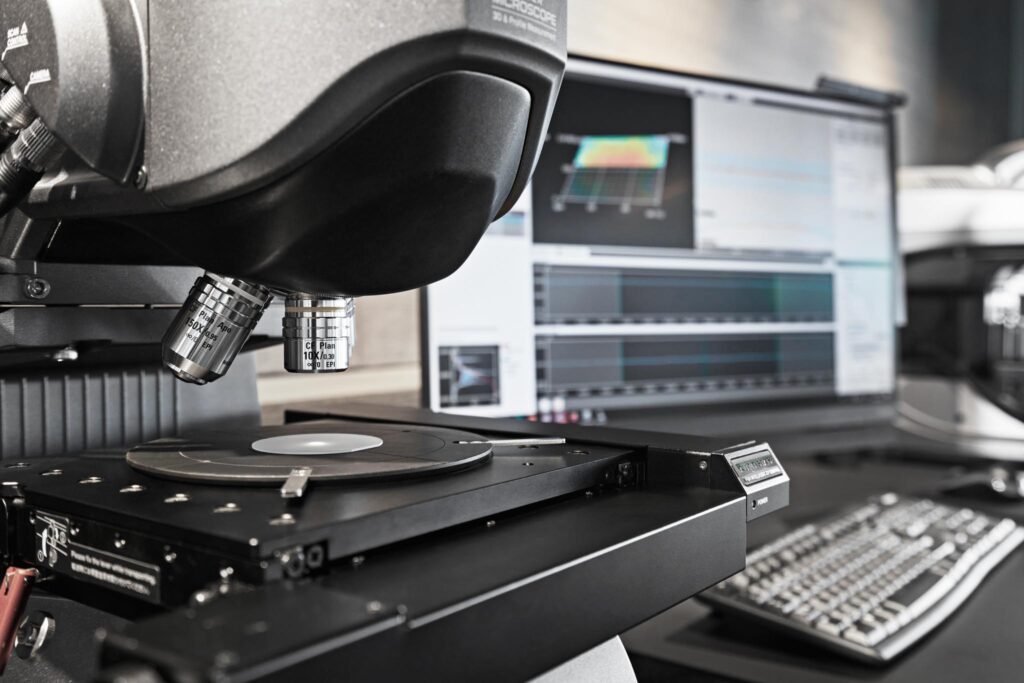
Microscopy is a central tool in metallography for analyzing microstructure, grain size, and material defects. Prepared samples are examined under an optical microscope or scanning electron microscope (SEM) in order to make phases, pores, or cracks visible.
The method supports quality control, failure analysis, and material development, delivering precise and reproducible results.
Pureon polishing media enable the production of surfaces that are microscopically smooth.
This high surface quality is essential because it allows optimal metallographic analysis of the microstructure. Disturbing factors such as roughness, scratches, or polishing marks are prevented through the use of Pureon polishing media, ensuring precise examination of the sample under the microscope.
Support for Sample Preparation
Careful sample preparation is essential for precise and reproducible metallographic analyses. Pureon supports laboratories and companies with high-quality consumables and extensive preparation expertise.
Our Surface Lab is equipped with modern polishing machines, allowing samples to be efficiently ground and polished to achieve flat and parallel surfaces. With the right materials and procedures, you can ensure that your metallographic investigations are reliable and meaningful.
General FAQs on Materialography
1. What is materialography?
Materialography is a materials testing method used to analyze the internal microstructure of metals and alloys. Through cross-section preparation and microscopic examination, structure, grain size, phases, and potential defects can be made visible.
2. What is materialography used for?
Materialographic investigations are used in quality assurance, failure analysis, research, and process optimization to evaluate material properties and monitor manufacturing processes.
3. What information does a materialographic examination provide?
It provides insights into microstructure, phase distribution, grain size, inclusions, and deformations, which are essential for evaluating materials.
4. Is materialography a destructive testing method?
Yes. Materialography is considered a destructive testing method because material samples must be extracted and prepared, meaning they cannot be returned to their original state.
FAQs on Materialography at Pureon
5. What role do consumables play in materialography?
Consumables such as grinding and polishing media form the basis for precise and reproducible sample preparation. Pureon offers coordinated solutions for the entire materialography process.
6. How does Pureon support materialographic testing processes?
Pureon provides optimized preparation media and systems that ensure consistent sample quality and enable reliable material analysis.
7. For which materials does Pureon offer solutions?
Pureon develops solutions for materialography across a wide range of materials, including steels, aluminum alloys, hard metals, and ceramic materials.
8. Why is reproducible sample preparation important?
Reproducible preparation is essential to obtain comparable and traceable results. Pureon places particular emphasis on consistent processes that ensure the highest analysis quality.
9. How does Pureon support digital materialography?
Only properly prepared samples enable reliable digital evaluation and the use of materialography software. Pureon’s high-quality preparation media create the foundation for digital image analysis and precise evaluation.