
Polishing for Space: Pureon Consumables in Precision Optics for the Artemis Mission
- Blog
- Insights
-
Oct 07
- Share post
Polishing for Space: Pureon Consumables in Precision Optics for the Artemis Mission
When the Artemis mission orbited the Moon this April, the crew of the Orion spacecraft looked out through windows brought to the highest precision with a Pureon product. What space demands ranks among the most exacting requirements anywhere: optical components must withstand conditions that scarcely any other industry knows – and the expertise behind them matters far beyond aerospace.
Spaceflight leaves no margin for error. Optical components aboard satellites, telescopes and spacecraft must combine minimal weight with maximum reliability, withstand extreme temperature gradients and radiation, and perform without any possibility of in-service maintenance. Meeting these constraints forces manufacturers to push surface-finishing processes to the limit of what is technically achievable. It is precisely this regime – nanometre-scale accuracy, long qualification cycles, lot-to-lot consistency over years – in which Pureon’s products for the surface processing of high-tech materials are designed to perform.
Ultra-Sol OPTIQ PRO on board Orion
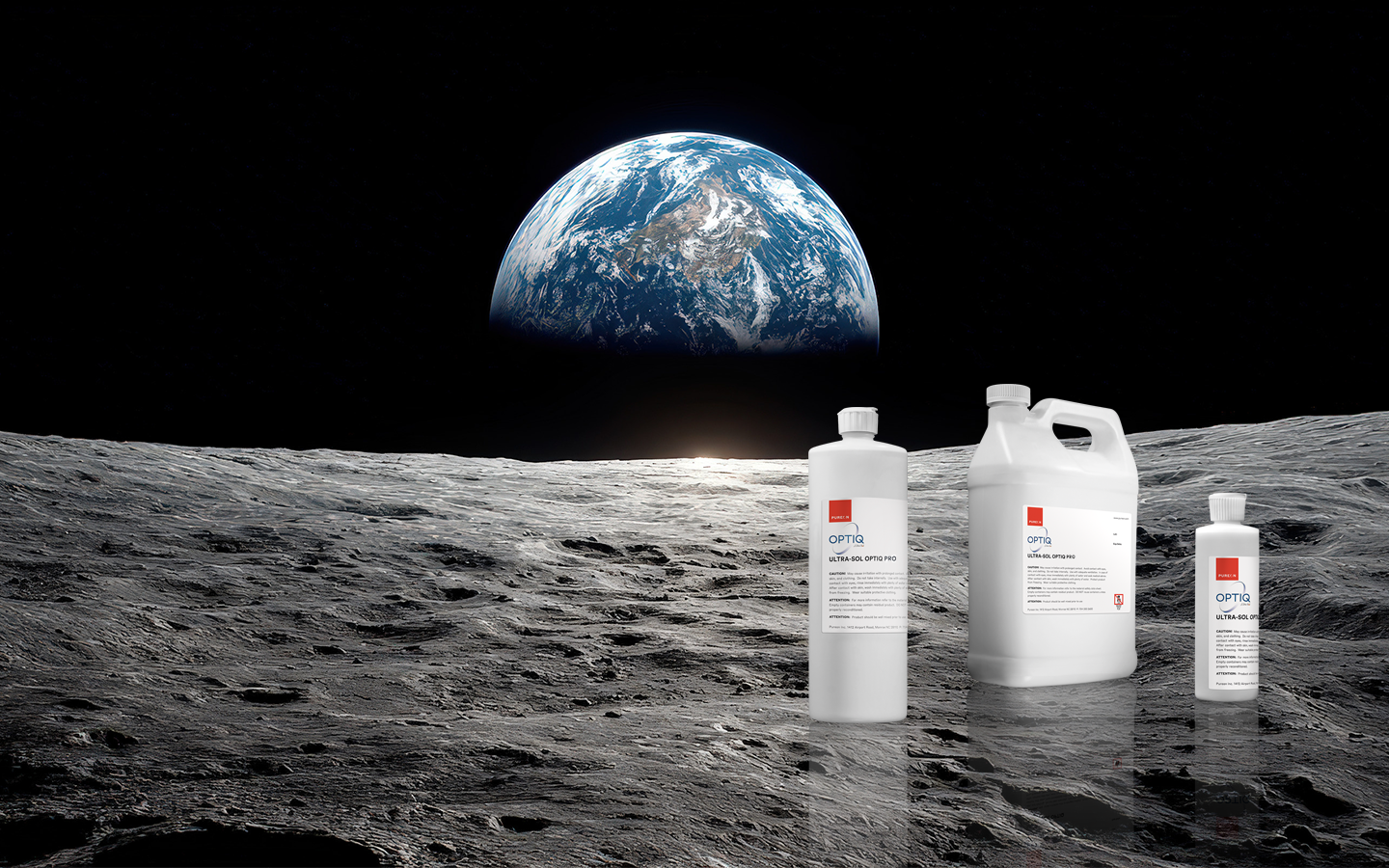
The windows of the Orion spacecraft that flew to the Moon during the Artemis mission in April were polished to high precision using Pureon Ultra-Sol OPTIQ PRO, a high-purity cerium oxide slurry developed for the precision polishing of borosilicate glass, fused silica and glass ceramics.
The case for such tight tolerances becomes clear when the consequences of deviation are considered. A window surface that is not optically flat can distort the view and compromise the structural integrity of the component. Where surface irregularities or contamination are present, it can also weaken performance against radiation. Spacecraft windows are typically multi-layer assemblies: a dense, optically demanding core is combined with additional panes to manage weight.
Each optical surface must meet exacting flatness requirements across its full aperture. The clarity with which the crew observed Earth and the lunar far side is, in this sense, a direct function of finishing quality.
Involvement in a lunar program is not an isolated case for Pureon. The company has been a long-standing supplier to space and scientific programs in Europe and the United States, including contributions to the precision finishing of mirror optics for major astronomical instruments.
Accuracy at the nanometre scale
The defining challenge in space optics lies in the demands placed on the components themselves: nanometre-scale accuracy in roughness and flatness, precise geometric dimensions, thermal stability and resistance to radiation. These are the parameters that determine whether an instrument can perform reliably once it is beyond reach.
“Spaceflight relies on a great many precision optical components that have to be extremely accurate, robust and reliable – whether in satellites, telescopes or space probes,” says Angelo Di Nardo, General Manager EMEA Sales at Pureon. “We’re talking about precision in the nanometre range, in roughness as much as in flatness.”
The scale of these requirements is well illustrated by the field of large ground-based telescopes. Modern instruments of this class carry primary mirrors several metres – in the most ambitious projects, tens of metres – across, often assembled from hundreds of individual segments that together must behave as a single optical surface.
Polished surface accuracies on the order of a few to ten nanometres are typical, and they must hold not at isolated points but across the entire mirror. For scale, a human hair is roughly a thousand times thicker than such a tolerance. Optics of this calibre allow astronomers to detect faint, distant objects and to probe regions of the cosmos far beyond the reach of earlier generations of instruments.
For the finishing of large-format optics of this kind, Pureon supplies polishing slurries in combination with compatible polishing cloths. The choice of slurry depends on the material and the application: cerium oxide, diamond suspensions, aluminium oxide or colloidal silica. Very hard substrates such as sapphire call for diamond particles, while softer glasses are processed with other abrasives. Polishing cloths are likewise selected by hardness, compressibility, thickness and surface structure – from polyurethane and polyester-fibre felt to polymer cloths – each matched to the surface being produced.
High-performance surfaces well beyond aerospace
The same competencies that finish spacecraft windows and telescope mirrors feed into a wide range of sectors: “We focus on surface preparation solutions for high-tech materials, and that takes us everywhere – from hip implants in the medical sector to spacecraft, and everything in between,” says William Gemmill, Ph.D., Chief Innovation Officer at Pureon.
In practice, that means medical technology, cameras and metrology, semiconductor manufacturing, and laser and sensor optics. From an endoscopy lens under a millimetre in diameter to an optic more than a metre across, wherever glass, crystal or specialty materials must be brought to the highest surface quality, precision finishing is the enabling step.
This breadth – from components used in medical technology to parts destined for spacecraft – rests on a single principle: products that are rigorously tested and consistent from lot to lot over extended periods. Programs such as space telescopes and lunar missions run over many years and depend on suppliers able to guarantee stable quality and reliable supply across the full duration. Pureon’s model is built around exactly this kind of long-term process reliability and partnership.
Whether in a lunar mission or a deep-space telescope, precision finishing is rarely visible in the final product – but it determines what the most demanding optical systems can achieve.
Looking for the right finishing solution for your optical components?
Explore our precision optics portfolio or talk to our specialist about your application.

Angelo Di Nardo
- General Manager EMEA Sales
- +41 76 583 55 72
- adinardo@pureon.com