
Pureon Nanodiamonds Power Cutting-Edge Quantum Research: From the Lab to the Future
- Blog
- Insights
-
Jun 08
- Share post

Pureon Nanodiamonds Power Cutting-Edge Quantum Research: From the Lab to the Future

A new peer-reviewed publication demonstrates how Pureon’s high-purity nanodiamonds are enabling breakthrough magnetic field sensors – and why supporting academic science has always been part of who we are.
At Pureon, we believe that great science begins long before a product reaches the market. For many years, we have been an active partner to universities and research institutes — supplying precision nanodiamond materials to scientists who are pushing the boundaries of what is possible. This commitment recently bore remarkable fruit: a team of researchers from TU Bergakademie Freiberg and the Leibniz-Institut für Oberflächenmodifizierung (IOM) Leipzig published a landmark paper in the Journal of Sol-Gel Science and Technology (2026) that features Pureon nanodiamonds at its core.
“The nanodiamonds used in this study were sourced from Pureon and consist of monocrystalline particles with sizes ranging from 0.75 to 1.25 µm.”
— Weigel et al., Journal of Sol-Gel Science and Technology, 2026
What the researchers achieved
The study demonstrates a new type of all-optical magnetic field sensor built from a glass optical fiber coated with a tailor-made sol-gel layer containing Pureon nanodiamonds. The nanodiamonds are not ordinary particles — they contain nitrogen-vacancy (NV⁻) centers, atomic-scale quantum defects in the diamond crystal lattice that are extraordinarily sensitive to magnetic fields.
When a magnetic field is applied, the photoluminescence (red light) emitted by the NV⁻ centers in the nanodiamonds changes measurably. The sensor detects this change through the fiber itself — no wires, no complex optics needed at the sensing tip. The result is a compact, galvanically isolated sensor that can work in harsh or remote environments where conventional sensors fail.
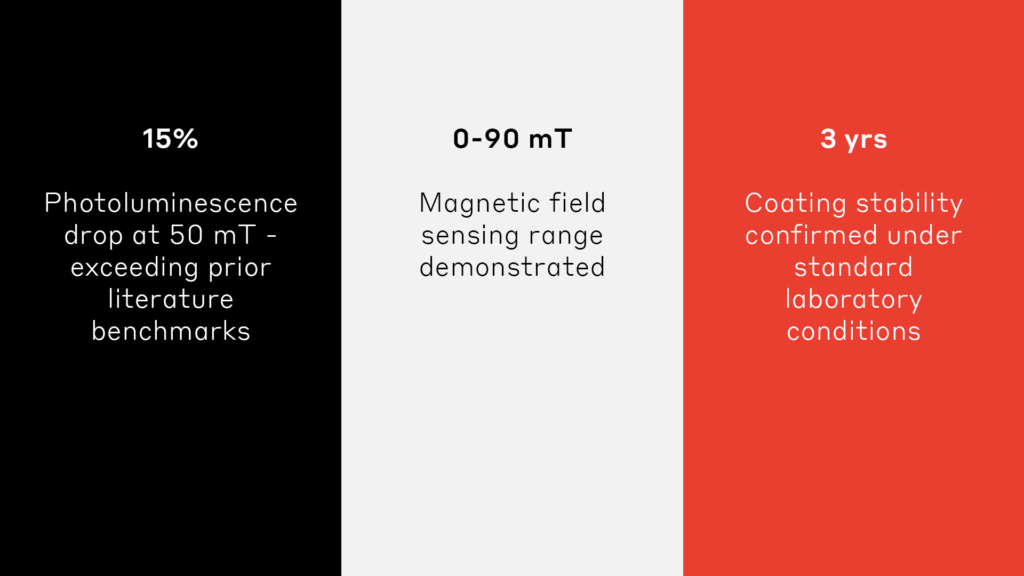
The sensor achieved a 15% suppression of NV⁻ photoluminescence at 50 mT — a result that surpasses earlier microwave-free diamond-based sensors reported in the literature. The sol-gel matrix, developed to be flexible, chemically resistant, and optically transparent, successfully embedded Pureon nanodiamonds at concentrations between 4 and 74 wt% without cracking or delamination.
Why this matters for industry
The practical implications of this technology are significant. The sensor’s high sensitivity in the 0–50 mT range, demonstrated here at proof-of-concept stage, suggests strong potential for quality assurance in power electronics — inspecting semiconductor devices and integrated circuits through magnetic current imaging. Its optical fiber design allows it to monitor magnetic fields inside battery packs and high-electromagnetic-interference environments that defeat conventional sensors.
And because the sensing mechanism is rooted in quantum spin physics, the sensor exhibits no magnetic hysteresis — a key advantage over magnetostrictive and magnetic-fluid-based alternatives. Unlike conventional materials, it retains no magnetic memory, delivering the same accurate reading regardless of whether the field is increasing or decreasing.
Our commitment to academic science
Pureon has been supplying nanodiamonds to research groups across Europe and beyond for many years. We understand that fundamental research is the seedbed of tomorrow’s applications — in quantum sensing, biomedical imaging, materials science, and beyond. Providing researchers with reliable, high-purity nanodiamond materials is not just a business transaction for us; it is an investment in knowledge. Our role is to be the trusted materials foundation that makes breakthroughs like this possible.
In this study, Pureon’s contribution is explicit: our monocrystalline nanodiamonds served as the active sensing element. Beyond the material supply, Dr. Christian Laube of the Leibniz-Institut für Oberflächenmodifizierung — a co-author of the publication — supported the project through expertise in nanodiamond processing and NV⁻ center creation, reflecting the kind of deep technical collaboration we value.
Research Partners in this Study
Collaborative institutions using Pureon nanodiamonds:
The paper unites expertise across three institutions, with Pureon materials at the foundation of the experimental work:
- TU Bergakademie Freiberg — Institute of Inorganic Chemistry
- TU Bergakademie Freiberg — Institute of Applied Physics
- Leibniz-Institut für Oberflächenmodifizierung (IOM), Leipzig
- Fraunhofer IISB, Erlangen
Pureon nanodiamonds: trusted by researchers worldwide
What makes Pureon nanodiamonds the material of choice for precision research? Our particles offer exceptional crystal purity, consistent size distribution, and a well-defined surface chemistry — properties that are non-negotiable when the sensing mechanism relies on atomic-scale quantum defects. Researchers can trust that the NV⁻ centers in our nanodiamonds will perform consistently, batch after batch.
Whether you are exploring quantum sensing, bioimaging, drug delivery, or advanced coatings, we welcome the opportunity to support your work. We offer technical consultation alongside material supply — and we are proud when the science our nanodiamonds enable makes it into the peer-reviewed literature.
Reference:
Sol-gel processing meets quantum sensing: integrating NV⁻-containing nanodiamonds into a fiber-based magnetic field sensor
Weigel M., Albrecht A., Beyer J., Kraushaar K., Laube C., Knolle W., Heitmann J.
Journal of Sol-Gel Science and Technology, Vol. 118, Article 8 (2026)
Published online: 24 March 2026 · https://link.springer.com/article/10.1007/s10971-026-07136-w
Interested in collaborating with Pureon? We supply nanodiamonds for academic and industrial research — and we enjoy being part of the science.
We are happy to share our knowledge with you
and remain at your disposal for any further questions.

Dr. Dirk Heinemann
- Senior Manager Business Development
- +49 152 06192748
- dheinemann@pureon.com